
Project:
Optimisation of the Ceramic Fibre Production Furnace
Location
USA
Client
Unifrax
Expertise
CFD
Keywords
industrial mixing reactor, petrochemical process, multiphase mixing
This 2022 assignment for Unifrax Ltd focused on "Optimisation of the Ceramic Fibre Production Furnace" within the process and manufacturing sector. Using computational fluid dynamics (CFD) and multiphysics simulation, the team translated the existing project brief into a structured technical assessment. The work was intended to show why the system behaved as it did, how performance changed across credible scenarios, and which interventions offered the strongest engineering value.
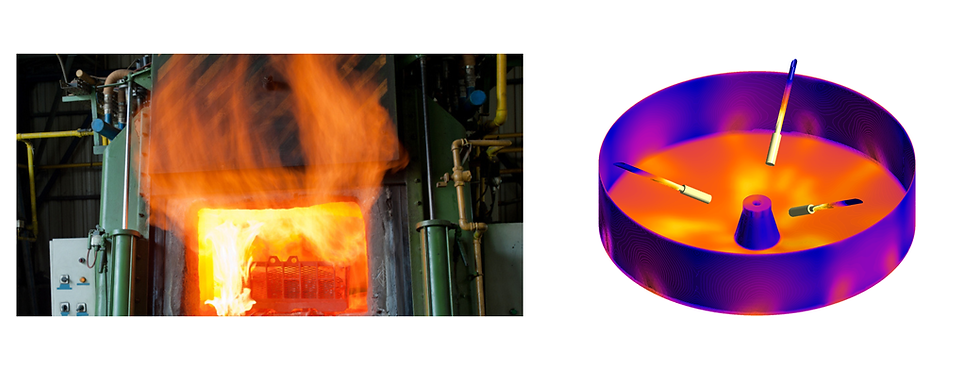
The aim of this project was to simulate a large industrial furnace and its operation with the purpose of identifying ways to reduce energy consumption and reduce its carbon footprint. The project was completed in 2 different stages and an accurate 3D model was built which included all the details of the furnace, heaters, nozzle output, cooling jackets and ventilation, etc. The results focused on temperature and melting profiles across the furnace and different heater locations were modelled to identify any potential savings. A parametric study was conducted to find the optimum location of the heaters. The simulations included complex heat transfer models and multiphase flow and the results were successfully compared against the experimental data provided by the client. Ultimately the new optimised design enabled the client to save significant amount of energy in running the furnace.
The methodology centred on a detailed three-dimensional furnace CFD model with multiphase and conjugate heat-transfer physics. The representation retained the furnace chamber, heaters, nozzles, cooling jackets, ventilation and material regions governing melting and thermal uniformity. Boundary and operating conditions covered the baseline operation, heater locations and powers, representative production conditions and the experimental data available for validation, with material, fluid and equipment properties assigned from the available design information. Resolution was concentrated in regions where steep velocity, thermal, concentration or phase gradients were expected, while the overall model remained efficient enough to compare several credible configurations. This balance allowed system-level performance to be linked to the local mechanisms responsible for it.
The assessment compared heater placement and operating changes intended to reduce energy use and carbon emissions. Performance was judged using temperature and melting profiles, heat flux, flow circulation, hot and cold zones, energy input and agreement with measured plant data. Results were reviewed through quantitative summaries and engineering visualisations, such as contours, vectors, streamlines, sections and time histories, selected to suit the physics. Important assumptions and operating uncertainties were considered so that the recommendations relied on repeatable comparative trends rather than a single nominal case.
For Unifrax Ltd, the principal value was an implemented furnace configuration with improved efficiency and a lower operational carbon footprint. The final evidence linked each recommendation to the relevant model or process output, making it suitable for internal design reviews, supplier or contractor discussions and, where applicable, planning, safety or regulatory dialogue. The work also created a reusable baseline that can be updated as geometry, operating data or test results become available, reducing the cost and risk of later design iterations.

