
Computational Fluid Dynamics (CFD) Consultancy

Mansim is an international CFD consultancy firm helping engineering teams understand complex flow, heat-transfer and transport behaviour, compare design options and reduce risk before committing to physical changes.
Our CFD experts combine advanced numerical methods, rigorous validation and industrial experience across data centres, buildings, process and manufacturing, energy, oil&gas, healthcare and nuclear. From a focused design check to a high-fidelity multiphysics or optimisation study, every model is developed around the engineering decision you need to make. Our CFD experts all have world-class reputation with a minimum of a PhD degree in CFD from top class universities and Chartered Engineer (CEng) status.

15+ years
of world-class computational simulation
250+
peer-reviewed publications
200+
organisations supported
25+
countries served
ISO 9001
certified quality processes
What is Computational Fluid Dynamics (CFD)?
Computational fluid dynamics (CFD) uses numerical models to predict how liquids, gases, heat, particles and chemical species move through or around a product, process or environment. A real system is converted into a digital domain, divided into a computational mesh and solved against the governing conservation equations. The result is a detailed view of quantities that are difficult, costly or unsafe to measure directly, including velocity, pressure, temperature, concentration, residence time and heat transfer. Used well, CFD does more than create visualisations: it explains why a system behaves as it does, tests credible alternatives and gives engineers evidence for design, safety, compliance and investment decisions.
Mansim is one of the most advanced companies in the world in developing CFD techniques and applying them to complex industrial problems. Originating from the ManchesterCFD team at University of Manchester, the CFD team at Mansim has an international reputation in accuracy, reliability and speed of computational simulations, evident from our awards, peer-reviewed publications and credentials of our team members.


When is CFD Used?
Airflow and Ventilation Analysis
Assess air distribution, ventilation effectiveness, pressure control, contaminant movement and thermal comfort in buildings, hospitals, cleanrooms, industrial facilities and data centres.
.png)
Thermal Management
Identify hot spots, recirculation and cooling limitations in equipment, electronics, data centres, HVAC systems, furnaces and energy infrastructure.
.png)
Product Design Optimisation
Compare geometries and operating conditions to improve performance, reduce pressure loss, increase efficiency and shorten physical prototyping cycles.
.png)
Industrial Process and Multiphase Flow Analysis
Analyse mixing, drying, filtration, sprays, particles, bubbles, evaporation and reacting flows in vessels, reactors and manufacturing equipment.
_PNG.png)
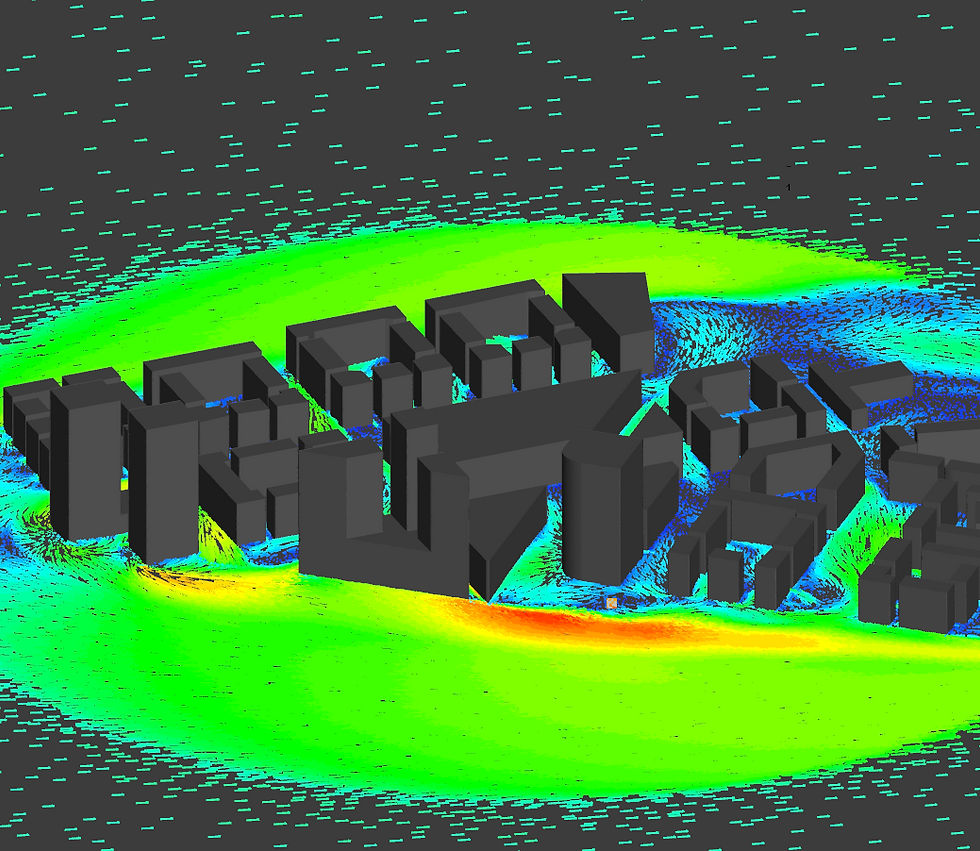
Aerodynamics, Wind Microclimate and Environmental Flow Modelling
Evaluate aerodynamic forces, wind microclimate, exhaust dispersion, plume behaviour and external airflow around products, buildings and infrastructure.
.png)
Safety, Compliance and Operational Resilience
Test smoke movement, gas dispersion, contaminant exposure, equipment failures and worst-case operating scenarios to support design approval and risk reduction.

Our Approach
01
Define the Challenge
We clarify the engineering question, performance criteria and required scenarios.
02
Review Inputs
We assess CAD, drawings, operating data and available measurements.
03
Build the Model
We prepare the geometry, mesh, boundary conditions and selected physical models.
04
Verify and Validate
We check convergence, mesh sensitivity and agreement with available evidence.
05
Test and Optimise
We compare operating conditions, design options, failure cases and mitigation measures.
06
Report Recommendations
We deliver clear findings, visualisations and practical engineering actions.
Our Approach
01
Define the Challenge
We clarify the engineering question, performance criteria and required scenarios.
02
Review Inputs
We assess CAD, drawings, operating data and available measurements.
03
Build the Model
We prepare the geometry, mesh, boundary conditions and selected physical models.
04
Verify and Validate
We check convergence, mesh sensitivity and agreement with available evidence.
05
Test and Optimise
We compare operating conditions, design options, failure cases and mitigation measures.
06
Report Recommendations
We deliver clear findings, visualisations and practical engineering actions.
Meet the Experts

Dr Amir Keshmiri
Dr Amir Keshmiri is an Associate Professor in Computational Fluid Dynamics at the University of Manchester, a Chartered Engineer and Fellow of the IMechE. He has led more than 40 major industrial CFD projects and is internationally recognised for CFD-led design optimisation, heat transfer and thermofluids. He has authored over 100 research publications and received multiple national awards for engineering innovation and impact.

Dr Pouyan Talebizadehsardari
Dr Pouyan Talebizadeh Sardari is a Senior Research Fellow at the University of Nottingham and leads Mansim’s R&D programme. He has published more than 150 journal articles and has been recognised among the world’s top 2% of scientists. His expertise spans thermal management, computational simulation and systems integration, with current research focused on Li-ion batteries, power electronics, electric motors, heat pumps and thermal energy storage.
Frequently Asked Questions
CFD Projects


Discuss Your CFD Project
Tell us the engineering decision you need to make, the information you already have and the timescale you are working to. Your enquiry will be reviewed by a CFD engineer, who will acknowledge your enquiry within one working day and identify the most proportionate next step.
