
Project:
Utilising novel fluid mechanics concept in ultra clean ventilation design for hospitals
Location
UK
Client
Medical Air Technologies Ltd
Expertise
CFD
Keywords
Ventilation, Ultra Clean Ventilation, HVAC
The project "Utilising novel fluid mechanics concept in ultra clean ventilation design for hospitals", delivered for Medical Air Technologies Ltd in 2015, addressed a practical healthcare challenge through computational fluid dynamics (CFD). Rather than producing simulation images in isolation, the study was organised around the client's design questions: what controlled performance, where the principal risks or losses occurred, and how the design or operating strategy could be improved.
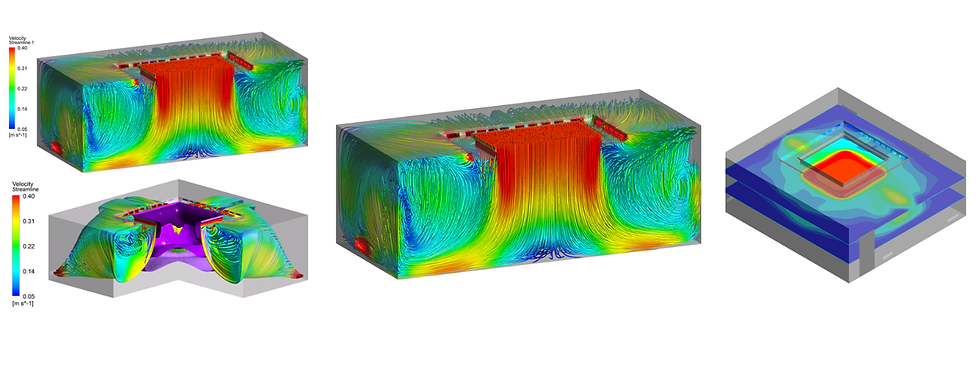
We applied a novel ventilation concept to improve air cleanliness and recovery times in critical healthcare spaces such as theatres and laboratories. Using computational fluid dynamics, we compared baseline HVAC layouts with enhanced ultra clean ventilation arrangements, representing supply diffusers, extraction strategy, thermal plumes and equipment and occupant heat loads. The analysis reported particle removal efficiency, recovery after disturbance, flow uniformity across the sterile field and draught risk for occupants. The model used realistic boundary conditions and representative operating scenarios, with mesh and solver settings chosen to resolve near‑field jets and entrainment. Sensitivity checks ensured robust comparative conclusions. The concept improved flow stability across the critical zone while avoiding undesirable recirculation that can re‑entrain particles. The results translate directly into HVAC design guidance for diffuser selection and placement, canopy geometry and control set points, supporting compliance aims and practical implementation by Medical Air Technologies.
The methodology centred on a detailed three-dimensional CFD model of the ventilation system, plenum and occupied clinical environment. The representation retained supply diffusers or HEPA panels, extraction grilles, pressure stabilisers, transfer paths, doors, furniture, equipment, occupants and the critical clean zone. Boundary and operating conditions covered normal and disturbed operating conditions, representative heat loads, pressure cascades, door gaps or openings, occupancy and relevant supply and extract set-points, with material, fluid and equipment properties assigned from the available design information. Resolution was concentrated in regions where steep velocity, thermal, concentration or phase gradients were expected, while the overall model remained efficient enough to compare several credible configurations. This balance allowed system-level performance to be linked to the local mechanisms responsible for it.
The assessment compared plenum, diffuser, canopy and extract configurations together with practical control or balancing changes. Performance was judged using supply uniformity, downward-flow quality, velocity across the critical zone, recirculation, stagnation, particle-removal performance, pressure relationships and draught risk. Results were reviewed through quantitative summaries and engineering visualisations, such as contours, vectors, streamlines, sections and time histories, selected to suit the physics. Important assumptions and operating uncertainties were considered so that the recommendations relied on repeatable comparative trends rather than a single nominal case.
For Medical Air Technologies Ltd, the principal value was evidence that supported clean-zone performance, product optimisation and standards-aware clinical ventilation design. The final evidence linked each recommendation to the relevant model or process output, making it suitable for internal design reviews, supplier or contractor discussions and, where applicable, planning, safety or regulatory dialogue. The work also created a reusable baseline that can be updated as geometry, operating data or test results become available, reducing the cost and risk of later design iterations.

