
Project:
Simulation of a Large Vertical Farming Unit
Location
UK
Client
Grow Up Farms Ltd
Expertise
AI Enabled Simulation
Keywords
Vertical farming airflow simulation
CFD heat transfer modelling
Controlled environment agriculture
In 2022, Grow Up Farms Ltd commissioned the project "Simulation of a Large Vertical Farming Unit" to address a defined challenge in the building and construction sector. The assignment combined computational fluid dynamics (CFD) and AI-enabled simulation and optimisation with a decision-focused engineering study. Its purpose was to explain the governing physical behaviour, identify the variables controlling performance, and convert the findings into practical recommendations for design, operation and future development.
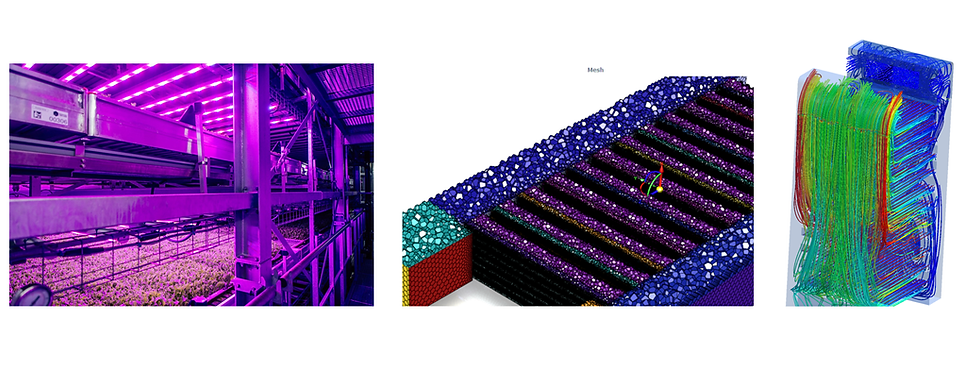
The aim of this project was to develop a detailed, modular numerical framework to simulate flow and heat transfer in a large-scale vertical farming unit (climate cell). We combined high-fidelity CFD with machine-learning acceleration (a fast surrogate model, trained on a judicious design of experiments from the CFD). An active-learning loop iteratively selected the most informative cases for additional CFD runs, reducing total compute while expanding scenario coverage. This hybrid approach preserved the governing physics (radiation, convection, buoyancy, moisture transport, turbulence and crop-bed porosity) while enabling much faster what-if analyses for design optimisation. The framework assessed the impact of supply temperature/humidity set-points, rack layouts, diffuser strategies, and lighting heat loads on chamber performance. Effects of heat transfer, velocity and pressure on the crops were captured qualitatively (contours, streamlines, vectors) and quantitatively (averaged values, uniformity indices, and surrogate-predicted response surfaces). This provided the client with a robust tool for optimisation and operational planning. Vertical farming, including this state-of-the-art facility, plays an important role in achieving a sustainable, net-zero future and contributes significantly to food security. This work has continued in additional phases to scale up the climate cell.
The methodology centred on a modular CFD digital twin accelerated by a machine-learning surrogate and active-learning workflow. The representation retained the climate cell, crop-bed porosity, racks, supply and return paths, lighting, radiation, moisture transport and buoyant heat transfer. Boundary and operating conditions covered temperature and humidity set-points, rack layouts, diffuser strategies, lighting loads and operating schedules across a broad design space, with material, fluid and equipment properties assigned from the available design information. Resolution was concentrated in regions where steep velocity, thermal, concentration or phase gradients were expected, while the overall model remained efficient enough to compare several credible configurations. This balance allowed system-level performance to be linked to the local mechanisms responsible for it.
The assessment compared design and control combinations screened rapidly by the surrogate and re-verified with high-fidelity CFD. Performance was judged using air speed, pressure, temperature, humidity, crop-zone uniformity, radiation and heat-load response, energy use and surrogate-predicted trade-offs. Results were reviewed through quantitative summaries and engineering visualisations, such as contours, vectors, streamlines, sections and time histories, selected to suit the physics. Important assumptions and operating uncertainties were considered so that the recommendations relied on repeatable comparative trends rather than a single nominal case.
For Grow Up Farms Ltd, the principal value was a scalable optimisation tool for climate-cell design, set-point scheduling, energy efficiency and future expansion. The final evidence linked each recommendation to the relevant model or process output, making it suitable for internal design reviews, supplier or contractor discussions and, where applicable, planning, safety or regulatory dialogue. The work also created a reusable baseline that can be updated as geometry, operating data or test results become available, reducing the cost and risk of later design iterations.

