
Project:
Multi-Twisted Blade Turbulator for Enhanced Heat Transfer
Location
UK
Client
In-house R&D
Expertise
CFD
Keywords
Multi-twisted blade turbulator
Heat transfer enhancement
Nuclear thermal hydraulics
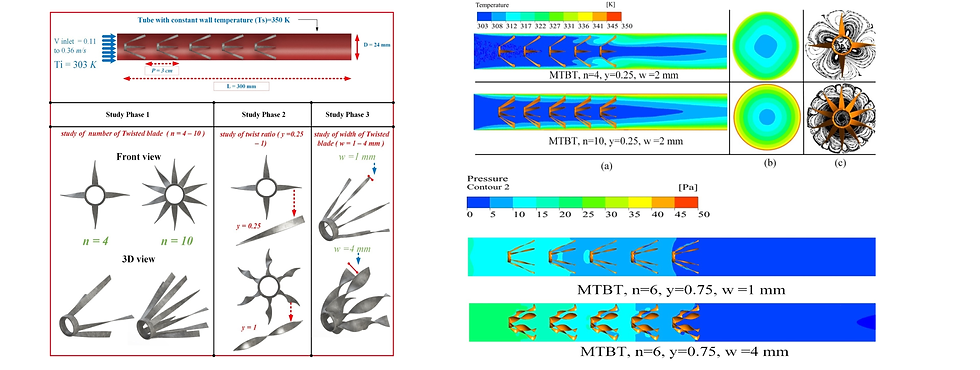
This project investigated an innovative method for improving heat transfer efficiency in thermal systems using a newly developed multi-twisted blade turbulator (MTBT).
Using advanced computational fluid dynamics (CFD) simulations, the research team designed a unique geometry that generates both swirling and radial fluid motion within a heated tube. This improves energy transfer without introducing additional mechanical complexity.
The study systematically varied three key parameters: the number of blades, from four to ten; the twist ratio, from 0.25 to 1; and the blade width, from 1 to 4 mm.
The optimal configuration featured six blades, a twist ratio of 0.75 and a blade width of 3 mm. This design achieved a performance evaluation criterion (PEC) of 2.8 and improved heat transfer by up to 273 per cent compared with a smooth tube, while maintaining a manageable pressure drop.
The findings are particularly relevant to the nuclear energy sector, where efficient heat removal and reliable cooling are essential for performance and safety.
In applications such as reactor cooling circuits, heat exchangers and steam generators, the MTBT design could support more compact, efficient and inherently safer thermal management systems.
Its passive operation and suitability for low-cost 3D printing also make it a strong candidate for retrofitting existing equipment and integrating into next-generation reactor designs. Potential applications include small modular reactors (SMRs) and fusion heat-recovery systems.
Beyond nuclear energy, the MTBT concept could be used in heating, ventilation and air conditioning (HVAC), energy conversion and industrial cooling systems.
Future research could explore combining the design with nanofluids or applying machine-learning optimisation to deliver adaptive thermal performance. This could contribute to the development of more sustainable and energy-efficient thermal systems.

