
Flow-Blurring Atomisation: From Multiphase Flow Regimes to Industrial Spray Design
Atomisation is central to many engineering systems, but it is rarely a simple problem of “making droplets smaller”. In practical devices, the quality of atomisation depends on how the liquid, gas, injector geometry and operating conditions interact across highly unsteady multiphase flow regimes.
This is particularly important in flow-blurring atomisation, where gas and liquid interact inside or near the injector exit to generate intense mixing, ligament formation and spray breakup. The result can be a highly efficient atomisation mechanism, but also one that is sensitive to operating point, fluid properties and geometric design.
A recent Mansim-led publication in Physics of Fluids, “Statistical characterization of flow-blurring outflow regimes based on shadowgraph imaging”, investigates this behaviour experimentally using high-speed shadowgraph imaging and statistical regime classification. The work reflects a core part of Mansim’s R&D activity: combining advanced engineering, experimental diagnostics and data-driven analysis to turn complex multiphase flow behaviour into practical design insight.
Why flow-blurring atomisation matters
Flow-blurring injectors are relevant to a wide range of applications where fine, stable and efficient spray formation is required. These include cleaner combustion, hydrogen and alternative fuel injection, agricultural spraying, pharmaceutical processing, thermal management, advanced manufacturing and next-generation propulsion systems.
In each case, atomisation performance affects more than droplet size. It influences mixing rate, evaporation, reaction efficiency, deposition quality, cooling uniformity, emissions, stability and system reliability.
This makes regime behaviour important. A spray that appears acceptable at one operating point may shift into a different outflow state when the fluid viscosity changes, the gas-to-liquid ratio is adjusted, or the injector geometry is modified. For industrial design, understanding these transitions is often as important as predicting a single operating condition.
Mapping the outflow regimes
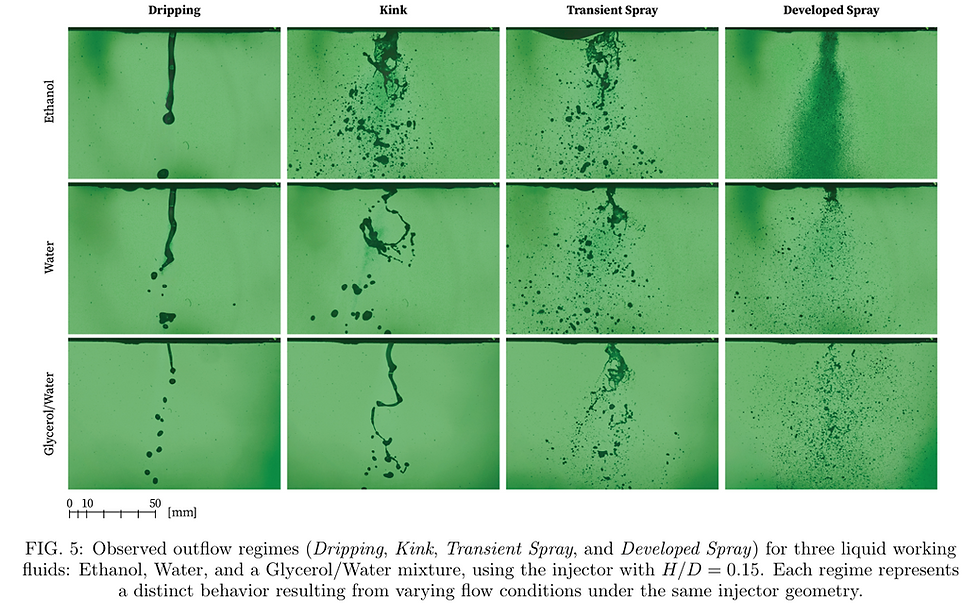
The study examined flow-blurring atomisation across a broad operating space, using three working fluids with different thermophysical properties and three injector geometries. High-speed shadowgraph imaging was used to capture the near-field outflow and classify the observed behaviour.
Four distinct regimes were identified:
Dripping represents the lowest level of atomisation, where liquid exits in a relatively coherent and poorly dispersed form.
Kink marks the onset of stronger gas–liquid interaction, with visible deformation and instability in the liquid structure.
Transient spray describes an intermediate state where the spray becomes more developed but remains highly unsteady.
Developed spray corresponds to a more intense and dispersed atomisation regime, where the outflow exhibits stronger breakup and wider spray formation.
These regimes form an ordered progression in atomisation intensity and flow unsteadiness. From an engineering perspective, this classification provides a more useful framework than treating atomisation as a single continuous response variable. It allows designers to ask a more practical question: under which conditions does the injector enter, remain in, or leave a desired spray regime?
Geometry cannot be treated as a secondary parameter
A key finding of the work is that regime transitions cannot be described reliably using a single operating variable. Individual dimensionless parameters show overlap between regimes, especially in the intermediate states, where the flow is most sensitive and least cleanly separated.
This is important because many engineering correlations attempt to reduce spray behaviour to a small number of operating ratios. While useful, these simplified descriptions can miss the coupled nature of the problem.
The study shows that injector geometry has a direct influence on regime behaviour. In particular, changing the gap-to-orifice ratio alters how the gas and liquid interact before discharge, which affects the resulting outflow mode. This means that operating maps developed for one geometry may not transfer directly to another without accounting for geometric effects.
For industrial injector design, this is a critical point. A geometry that performs well for one fluid or operating envelope may not deliver the same regime stability when scaled, modified or used with a different liquid.
Statistical analysis as a design tool
The publication goes beyond visual classification by applying statistical analysis to the operating parameter space. Class-conditioned probability density functions were used to examine how different regimes occupy regions of the dimensionless parameter space.
This approach is useful because spray transitions are not always sharply separated. In real systems, regime boundaries can be probabilistic, especially when the flow is unsteady and sensitive to small changes in pressure, flow rate or fluid properties.
By analysing the regimes statistically, the study provides a basis for reduced-order descriptions of regime transition. This can support faster screening of operating conditions, improved injector selection and more robust experimental or computational design workflows.
For Mansim, this is where fundamental research connects directly with industrial simulation and optimisation. Experimental regime data can inform CFD modelling development, validate multiphase flow predictions and guide design-space exploration for practical systems.
From fundamental multiphase flow to industrial insight
Flow-blurring atomisation is a technically rich problem because it sits at the intersection of internal injector flow, gas–liquid interaction, free-surface instability, ligament breakup and spray formation. Capturing this behaviour requires more than a standard design calculation.
The Mansim study demonstrates how high-speed imaging, statistical characterisation and engineering interpretation can be combined to produce insight that is directly relevant to injector design and operating-condition selection.
This type of R&D is central to Mansim’s work. By connecting fundamental multiphase flow research with practical modelling and design needs, we help turn complex flow physics into more efficient, reliable and lower-emission engineering solutions.
As industries move towards cleaner combustion, hydrogen systems, high-performance cooling, precision spraying and advanced manufacturing, the ability to understand and control atomisation regimes will become increasingly important. Research of this kind provides the experimental and statistical foundation needed to design those systems with greater confidence. Source: https://pubs.aip.org/aip/pof/article-abstract/38/5/053314/3389268/Statistical-characterization-of-flow-blurring?redirectedFrom=fulltext


Comments